
Seaglass Shawl: Choosing colours
With a week to go until the start of the #seaglassCAL , it’s time to talk colours. What will you choose?

Thank you so much to everyone who entered the Seaglass Shawl giveaway last week! I wish I could have given you all a kit (including myself), but alas! There could only be one winner. So congratulations Kat! Your prize will be with you soon.
Last week I set up the Seaglass Shawl CAL page on Facebook too. I honestly thought I'd be wafting around on my own in there like a lonely tumbleweed, but we have almost 30 members from across the globe already! If you'd like to join in, just click here. You can add friends to the group, too, and if you're not into facebook (or also into instagram!) you can use the hashtag #seaglassCAL on IG.
[Reminder: the Seaglass Shawl crochet pattern is available to buy on Ravelry]
As the CAL doesn't officially start until May 7th, there's still time to get your yarn choices sorted out. In case anyone is struggling with what colours to combine, I thought I'd explain how Petra and I put together the kits.
I feel I should come clean here - the kits are 99% Petra's work. She sent me tons of beautiful yarn pictures with only the vaguest of suggestions from me. There's a reason she is the professional dyer out of the two of us. It was so hard to finalise them into a list of only 5 (4 plus the original), but some general questions I used to guide my choices were:
- what will look good closest to the face?
- is there enough contrast to keep things interesting?
- do the stitches come out as I intended them to or is the detail lost?
Colour by colour, then, my thought process went like this:
Main Colour (MC) - the colour which gives the shawl its overall character, but which also needs to look good next to the face. Should not drown out the other colours, so keep it fairly light. Bonus points for speckles, which can then be picked up in the other colours.
Contrast Colour 1 (CC1) - the colour which ties the whole multi-stitch section together. Should therefore look good next to ALL of the other colours. Can be light to medium in intensity, so as to provide enough contrast but still show off the detail of the cross-over stitch.
Contrast Colour 2 (CC2) - complements CC1 but still provides some contrast.
Contrast Colour 3 (CC3) - the bold "statement" colour used for the clusters and border. Be brave and choose something that provides a strong contrast.
Here is what all of that actually looks like in practice.


Having said all of the above, I should add that colour choices are of course completely personal. One kit that didn't make it to the shop but which I LOVE is this one:

image credit: Fru Valborg
It's more of a fade rather than the light-dark, cold-warm contrasting palette of the others, and I therefore felt it didn't stay true enough to MY design. But does that mean it can't be YOUR shawl? Of course not. Part of the fun of putting a design out there is seeing how others interpret it, and as it happens I've seen a similar combination pop up on instagram already. I have no doubt it's going to be beautiful.

PATTERN RE-RELEASE: Seaglass Shawl
Light and drapey, versatile and cosy - the Seaglass Shawl has it all. As fun to make as it is to wear, the main body of this triangular shawl works up quickly in easy TC filet stitch. It then moves into a section of beautiful, colourful mixed stitches, and is finished off with a delicate picot edge. And... there are kits!

Light and drapey, versatile and soft- the Seaglass Shawl has it all. As fun to make as it is to wear, the main body of this triangular shawl works up quickly in easy TC filet and solid TC stitch. It then moves into a section of beautiful, colourful mixed stitches, and is finished off with a delicate picot edge.
And... there are kits! To make the sample for this re-release I teamed up with Petra from Fru Valborg. She hand-dyes on the the most beautiful, cruelty-free merino yarn to produce original and exquisite palettes. There simply had to be kits!
But there is of course also choice: you can either buy the pattern on its own from my Ravelry store, or purchase a kit from the Fru Valborg webstore. Any purchase of a kit will INCLUDE a copy of the pattern at a 10% discounted rate, along with 2x 100g skeins and 2x 50g skeins of either pure merino yarn or a nylon + merino blend (so you'll be able to use any leftovers for socks!). The kit will retail at 835 SEK.

The Original Colourway: Glacier Bay Dark (CC3) | Azure (MC) | Muddy Pink (CC2) | Oak Light (CC1)
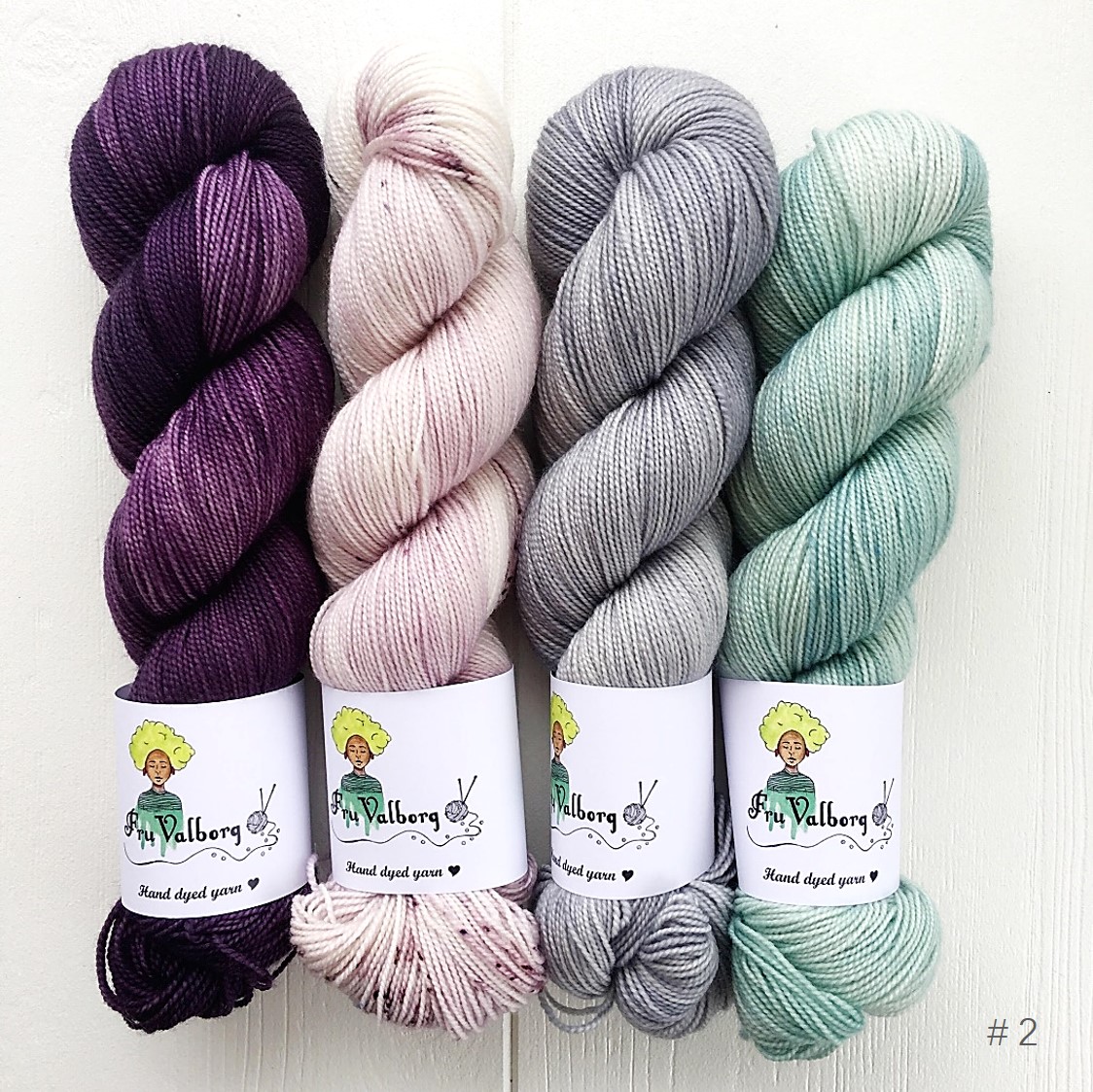
Amethyst (CC3) | Hold Your Breath (CC2) | Fog (CC1) | Ice Mint (MC)
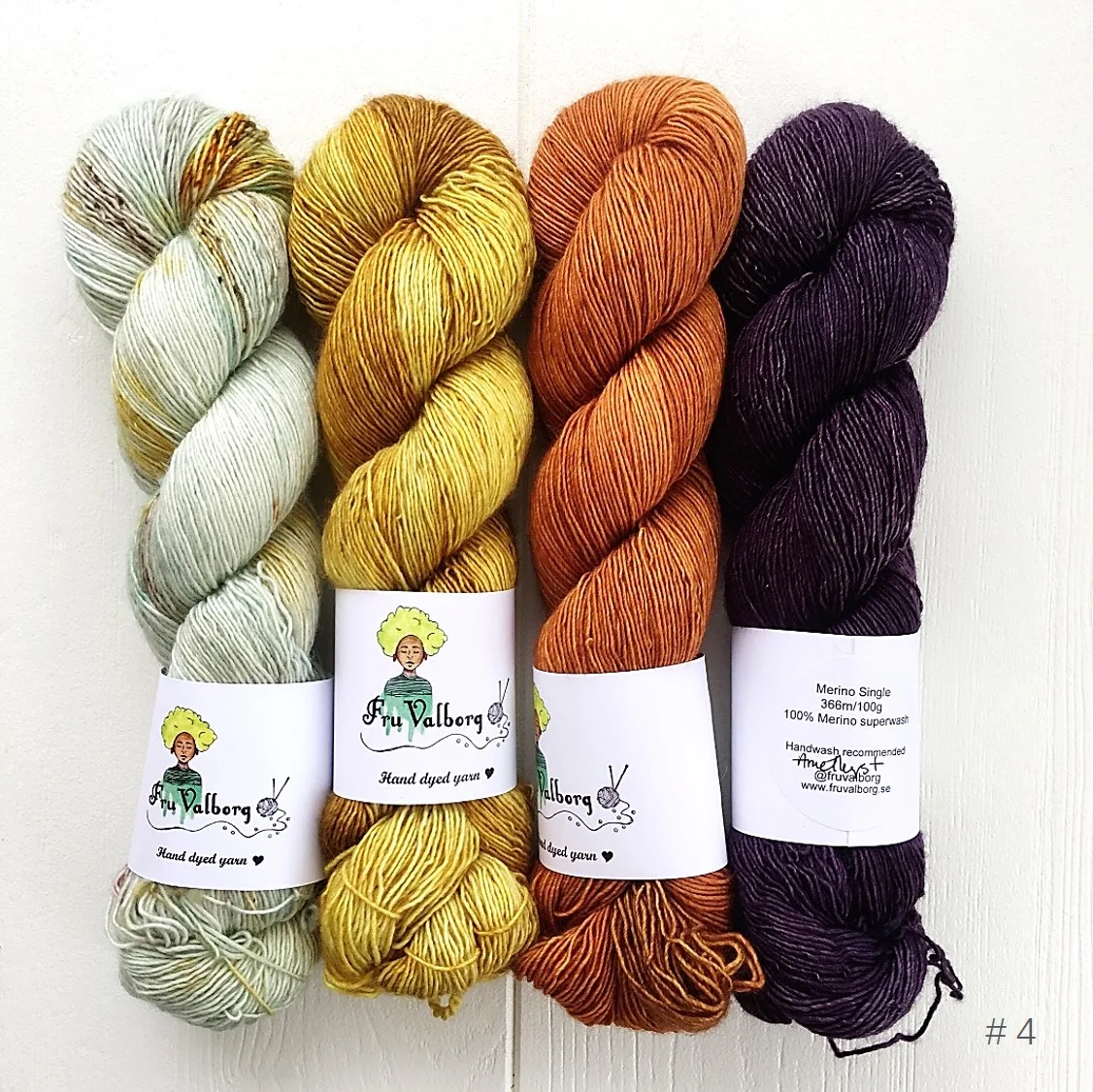
From Afar (MC) | Sweet Honey (CC2) | Flame (CC1) | Amethyst (CC3)

Fidelity (MC) | Chocolate (CC3) | Crazy Daisy (CC2) | Sweet Carolina (CC1)

Emmy Lou (CC1) | Ice Mint (CC2) | Mud (MC) | Storm (CC3)
We spent hours pouring over the colour combinations, and so along with the original colourway we hope there's something for everyone. Jewel or pastel, moody or light... And of course EVERYONE gets at least one speckle! Please note though: the above pictures show 4x 100g skeins, but the 2nd and 3rd contrast colours (CC2 and CC3) will come in 50g skeins. Do you have a favourite yet?
There will also be a CAL (crochet-a-long) and giveaway. More details to follow soon, so stay tuned.

Size
220 cm (top edge) x 150 cm (side edges) x 80 cm (middle top to tip)
Materials + Notions
3mm (D/3) crochet hook , or as required to obtain gauge
scissors
wool needle
Yarn: Fru Valborg Merino Single (fingering; 365m per 100g skein; 100% superwash merino) - 3 skeins in Azure (MC); 1 skein in Oak Light (CC1); 1 skein in Muddy Pink (CC2); 1 skein in Glacier Bay Dark (CC3)
With special thanks to Fru Valborg for providing yarn support
Actual Yardage Used:
MC (Azure) - 200g / 730m
CC1 (Oak Light) - 58g / 212m
CC2 (Muddy Pink) - 38g / 139m
CC3 (Glacier Bay Dark) - 16g / 59m
Yarn Alternatives
Any fingering to 4-ply yarn (look for a meterage of 340 to 380m per 100g) will result in a similar drape. Use 100% cotton for a light, summery shawl or a merino/merino+silk blend for a warm and luxurious feel.
Gauge
21 sts x 11 rows = 10 cm measured over main patt (3 rows of TC filet, 1 row of solid TC) after blocking.
NOTE: The original sample of this shawl, as it appeared in Crochet Now, uses TC filet st throughout for the main body of the shawl. This version uses a little less of the MC yarn and has a looser structure.
Construction
This triangular shawl is worked flat from the top down, with increases at the far edges and the tip.
Skill Level
Intermediate - includes simple increases and mixed stitches
Pattern
The pattern includes clear written instructions, UK to US term conversion chart, and a hand-drawn illustration (PDF only).
You can purchase the PDF download for 45 SEK (about $5.35) from my Ravelry Store, or visit Fru Valborg for a kit that includes both pattern + yarn.

This pattern originally appeared in Crochet Now issue no. 15.

The dreams of a 4.5-year-old boy
There was once a little boy, of a generally sunny but also pensive disposition, who often struggled with bad dreams.

There was once a little boy, of a generally sunny but also pensive disposition, who often struggled with bad dreams. Sometimes it was them darn zombies. His mama told him there's no such thing but, what do mamas know about these things anyway? And sometimes he dreamed his mama herself would leave, which was altogether worse. No amount of night lights or cuddly toys or dolly friends would make those dreams go away.

His mama said, I won't leave, I'll always be here for you one way or another. But she knew that words are sometimes not enough. So they put their heads together, and both agreed: a dreamcatcher. Because both knew, deep down, that the best way to soothe another person's soul is to give them something your own hands have made.
Two old embroidery hoops, leftover cotton yarn, some feathers pilfered from the Easter decorations box. New beads though, because, well... Shiny things. Irresistible.
And here is the result.


If you want to make a similar dreamcatcher, I was inspired by this one.

YARN REVIEW: Blacker Yarns Lyonesse
Lyonesse by Blacker Yarns is a 50/50 blend of linen and wool. Find out what it's like to work with and what to use it for.

What kind of yarn is it?
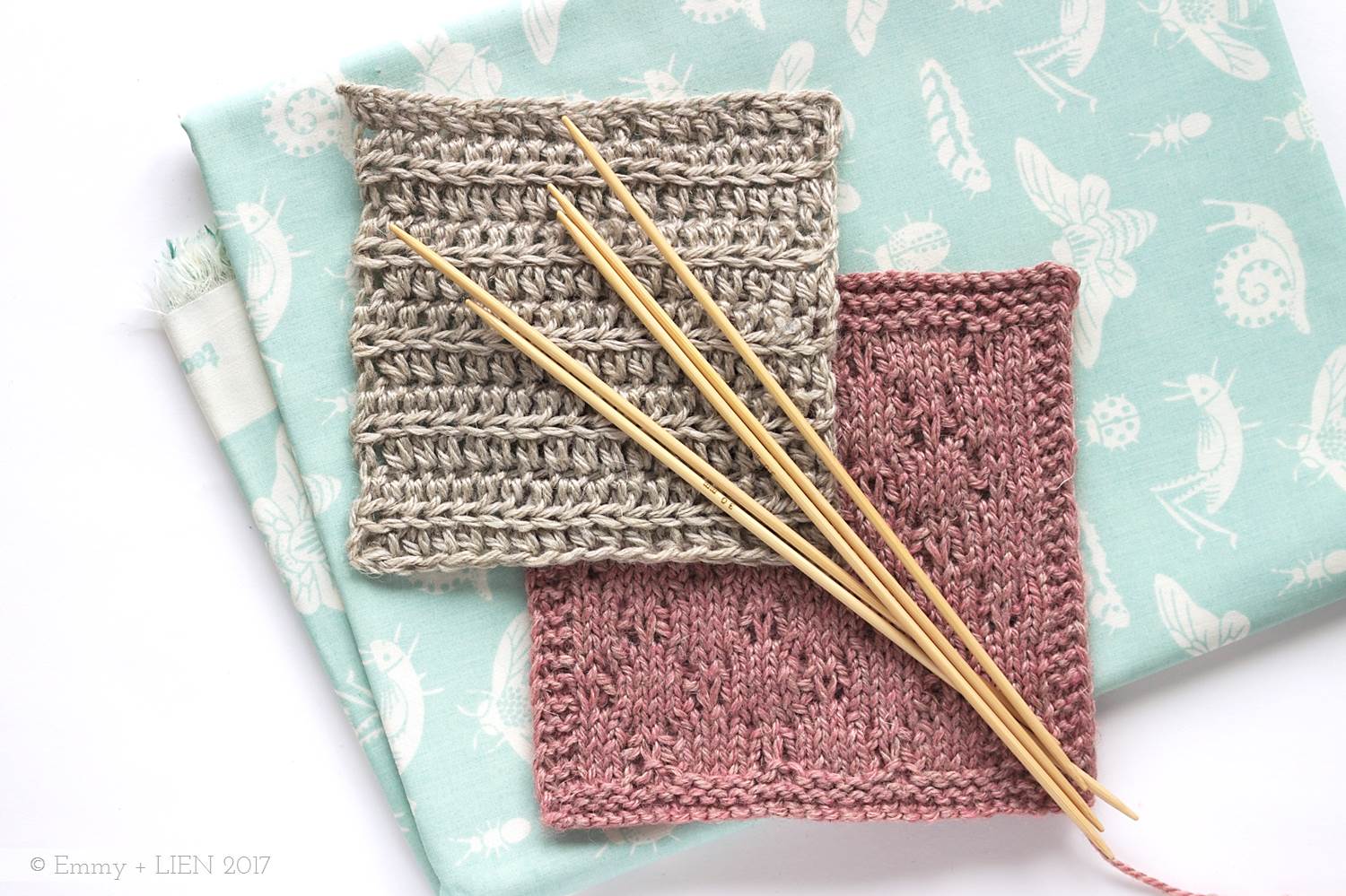
- Lyonesse by Blacker Yarns is a 50/50 blend of linen and wool (Falkland Island Corriedale or Merino). It's available in both 4-ply and DK weights. The swatches shown use the DK, with a 4mm hook for the crochet swatch and 3.5mm needles for the knitted one.
- The combination of linen and wool gives Lyonesse a very interesting feel; it's a little stiff at first but soon softens up. Once blocked it really relaxes into a wonderful suppleness.
- Lyonesse comes in a range of 15 shades, including one undyed neutral.


Who makes it?
Lyonesse is made by British company Blacker Yarns, who are part of specialist wool millers The Natural Fibre Company. The company's main focus is on high-quality, natural, UK-sourced and produced yarns. It pays fair prices for all the fleeces it buys, so as to help support British farmers. Animal welfare and appropriate waste disposal are also of high priority.
Plus Points?
- Each of the fibres used in Lyonesse brings its own characteristic to the finished material. The linen adds crispness and strength, while the wool lends softness and memory. In other words, what you get is excellent stitch definition with just a touch of fluffiness. It also has the typical "give" you would expect from linen, but doesn't go overly baggy thanks to the wool. It retains its blocked shape amazingly well.
- The shade range isn't huge, but it is versatile in that each colour has a good depth to it and is very wearable.
- Merino or similar wools can be quite fragile on their own, but the addition of linen makes this much more hardwearing. It is clearly meant to be used for items that will really be worn and loved for a long time.
Negatives?
- Stiff, dense fibres such as linen and cotton can be quite tough on the joints. Although this yarn is soft to the touch, I did feel fatigue in my fingers and wrist especially when crocheting with it for a long time.
- Availability of all the shades isn't constant, but depends on when each season's fleeces come in. Blacker are very helpful when you get in touch to ask about their stock though!
What should I use it for?
Lyonesse is a good mid-season to summer yarn and would make beautiful lacy or cabled garments as well as accessories.
Suggested pattern: Betty Bolero

Note: I was not compensated in any way for writing this review

YARN REVIEW: de rerum natura Ulysse
Ulysse by de rerum natura is a merino yarn produced in France in an ecologically and ethically sound way. Find out what it's like to work with and what to use it for.

What kind of yarn is it?
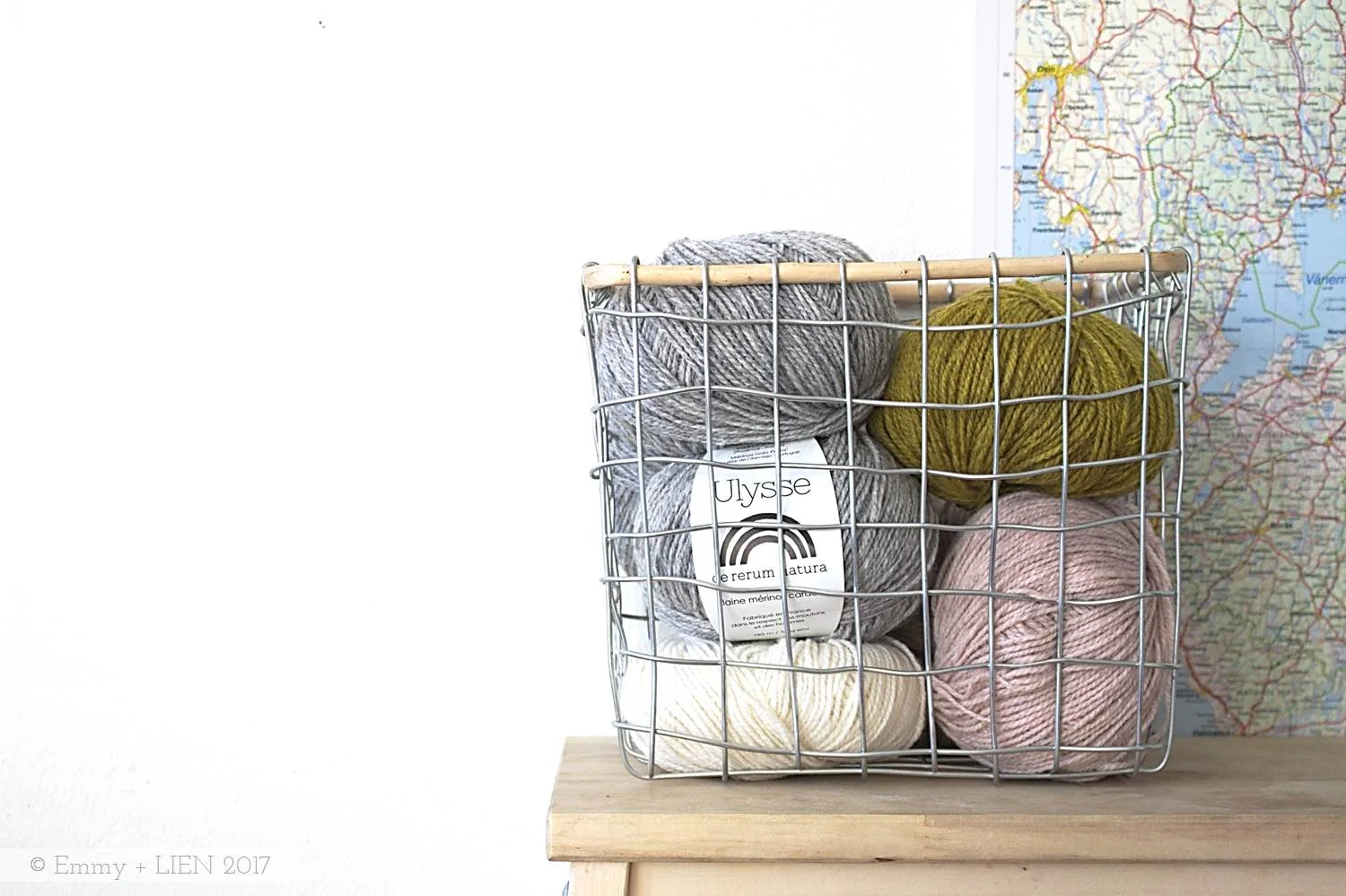
- Ulysse by de rerum natura is a carded, 100% merino yarn blended from two to three different sheep breeds.
- It's a 2-ply sport weight yarn with a recommended needle size of 3 to 3.5mm. As a loose crocheter, a 3mm hook works best for me. For knitting, 3.5mm wooden needles gave me 24 sts by 36 rows.
- As this is a non-superwash merino, it has a great structure with plenty of bounce and crunch. It does not feel like a slinky, shiny superwash merino at all. Rather, it feels soft in a natural, sheepy way.
- Ulysse comes in a range of 25 shades, including earthy neutrals, soft pastels and a few brights. All shades are available in 50g balls, and the neutrals are also available in 100g hanks.

Who makes it?
Ulysse is made by French company de rerum natura, who aim to create yarns that respect both the animals and people responsible for producing them. The sheep are reared humanely in France or Portugal, and all yarn processing is carried out as ecologically as possible in France.
Plus Points?
- Where appropriate, Ulysse is blended from the fleeces of both white and black merino sheep before being dyed. The result is an incredible depth of colour that manages to look rich as well as earthy.
- Thanks to its slightly crunchy, firm structure this yarn holds stitches very well and is an absolute joy to work with.
- Being merino, it's still soft and fluffy enough to consider wearing next to the skin. It softens further with time.
- It feels lightweight yet warm when worn.

Negatives?
- This yarn is reasonably easy to "break" - pull hard enough on a strand and it will come apart. Thankfully it isn't actually splitty, but when joining two strands with a knot, for example, care needs to be taken. I do also wonder how areas such as elbows would stand up to heavy wear.
- Ulysse should only be handwashed, so you may not want to use it for items that need washing frequently (i.e. baby knits!).
What should I use it for?
Ulysse is especially suited to colourwork such as fairisle, fine cables or lace. It works just as well for garments as for accessories - think feminine cardies, big beautiful shawls or fairisle beanies.
Suggested pattern: Hanabira cardigan

Note: I was not compensated in any way for writing this review

when Ruby met Maeve
About a year ago I decided to try being a little less random with my personal makes. It hasn't come easy to me; I've still ended up with some very last-minute makes and many more unfinished ones. Still, by the middle of last summer I did have one outfit that ticked all the boxes.

About a year ago I decided to try being a little less random with my personal makes. Less impulse buying of yarn, more looking at what would go with what is already in my wardrobe, planning a season ahead, that sort of thing. It hasn't come easy to me; I've still ended up with some very last-minute makes (I'm looking at you, 10-day birthday jumper) and many more unfinished ones. My wild optimism about the correlation between the outfits in my head and the ones my hands can actually produce has not been cured or even dampened, I would say.
Still, by the middle of last summer I did have one outfit that ticked all the boxes, that followed all the rules. Well, almost. I had impulse bought the fabric without the faintest notion of what I was going to do with it. But, once I'd spotted both Ruby and Maeve and thought, yes: I planned. I bought the patterns and the yarn.

I made both as per the instructions as opposed to winging it. I properly finished every last seam and tucked in every end, and then I WORE THEM. Now we've seen the last of the snow (I hope) and Spring seems to finally be around the corner (oh, I hope!), I plan on wearing them LOTS MORE.

Ruby
Ruby is a combined top and dress pattern by Made by Rae. I like her modern aesthetic, and the instructions are extremely well-written with lots of tips. I'd never sewn an adult garment to a pattern before so I was nervous initially, but I didn't have any issues at all. The little gathers at the bust were just enough of a challenge to be interesting, without having me tear my hair out.

You'll have to take my word for it that it does fit me, even though I can't show you now - 7 months pregnant! Stupidly I didn't ask anyone to take pictures when it did, actually, still fit. Next summer!

The fabrics are both organic cottons - the mustard one being woven and the flowery one voile - by Art Gallery Fabrics, and I love them. I want piles and piles more (but, time and money).
Maeve

The Maeve shrug is a design by Carie Bostick Hoge at Madder. As a knitwear designer she seem ubiquitous, and with good reason; her work has a classic, timeless feel to it without being stuffy. It is all just so, so wearable.
This shrug is a good one if you're new to garment knitting. Super-simple shaping on the arms, and then loads of mindless knit stitch for the back and garter stitch for the collar. That collar, that collar... The whole thingis drapey, comforting, and very easy to throw on over pretty much anything.
The yarn is Summer Wool by Pickles Oslo: a blend of 70% organic cotton and 30% merino wool. It's unbelievably soft and smooshy, without either the stiffness of cotton or the overly-processed feel merino can have. Despite the name "Summer Wool" it saw me through most of autumn as well. It's pilling a little bit now, but nothing outrageous.

So there you have it. When Ruby met Maeve I threw on my favourite old jeans and, of course, of course some mustard yellow shoes. I think they got on rather well, don't you?


YARN REVIEW: MoYa Whisper
MoYa Whisper is a line of 100% organic cotton in 19 soft, powdery shades. Find out what it's like to work with, what to use it for and where to get it.

What kind of yarn is it?
- MoYa Whisper is a 100% organic cotton. It's a standard Double-Knitting (DK) yarn, with a recommended hook size of 3.5 to 4.0 mm (needle size 3 to 4 mm). For a loose crocheter like me, 3.5 mm is spot on.
- This yarn is hand dyed, so each ball has its own unique colour gradation. The peach shade pictured above ranges from a very light baby pink to a dark raspberry. However, each ball within a dye lot has the same base colour, so they do of look good together.
- The colour range includes 19 powdery shades, with a good number of neutrals and a few delicious brights thrown in.

image credit: scaapi.nl
Who makes it?
MoYa Yarn is based near Cape Town in South Africa. The company is run by a mother and daughter team, who specialise in hand-dyed, unique yarns.

Plus points?
- MoYa Whisper has a high twist, meaning it absolutely does not split. When you're doing fiddly stitches such as puffs, this is a godsend!
- Like all cotton yarns it's fairly dense, but it still feels soft and supple to work with. I've found it softens up more over time, too.
- The colours are to. die. for.
- It's organic!
Negatives?
My only complaint is that MoYa yarns are still a little tricky to get hold of in some parts of the world. However, I know its distributors as working hard to change this. For European stockists you can check Scaapi's website, and the Australia & New Zealand market is covered by intambo.
What should I use it for?
MoYa whisper is perfect for baby and children's items such as blankets, sweaters, hats, etc. Even though cotton is usually recommended for wash cloths and the like, I wouldn't use this yarn for those - it's just too nice!
Suggested pattern: Peach Pocket Tunic

Disclosure: I received one ball of MoYa Whisper as a sample. The decision to write this review, and all opinions and words included in it, are my own.

A Yarnie's Take on Pantone Colour of the Year 2016
If you've been keeping track of my designs you'll know I'm not really a pastels sort of girl. After some yarn and cup faffery, however, I figured out how to make Pantone's pick for 2016 work for me.

In a first, Pantone has picked not one but two colours as Pantone Colour of the Year for 2016: Rose Quartz and Serenity.
If you've been keeping track of my designs you'll know I'm not really a pastels sort of girl. I don't dislike them - I just think their subtlety is a bit lost on me! As with all the colours Pantone picks, however, obviousness is not part of the game. What matters is your own interpretation and it's fascinating to see what designers, stylists and artists across the world come up with (you can keep track of all that on Pantone's dedicated Pinterest board).
To figure out how to make Rose Quartz and Serenity work for me, I decided to just have a play. A hint of yellow, my favourite notebooks...

The yarns pictured are by Vinnis Colours (blue) and MoYa (Pink), both kindly sent to me by Scaapi, and Sirdar (yellow). Although I don't think of these colours as "me", I do really like the softness of the picture and I think the palette would be beautiful for a crochet blanket or a delicate shawl.
Still, more colour faffery was needed (I know, my job is really hard). As I rearranged my cups and yarns it suddenly clicked:


pastels + neutrals + bolder colours = Ombre! Ole!
I really, really like this palette. I'm still thinking about what to make with it - any suggestions? - but whatever it is, it'll be fun. The pink yarn is by MoYa, as above, and the coral yarn is by Nurturing Fibres. The jute rope is one of many rolls I picked up at a gardening store!

How are you approaching Rose Quartz and Serenity?

TUTORIAL: Woven Shell Crochet Stitch
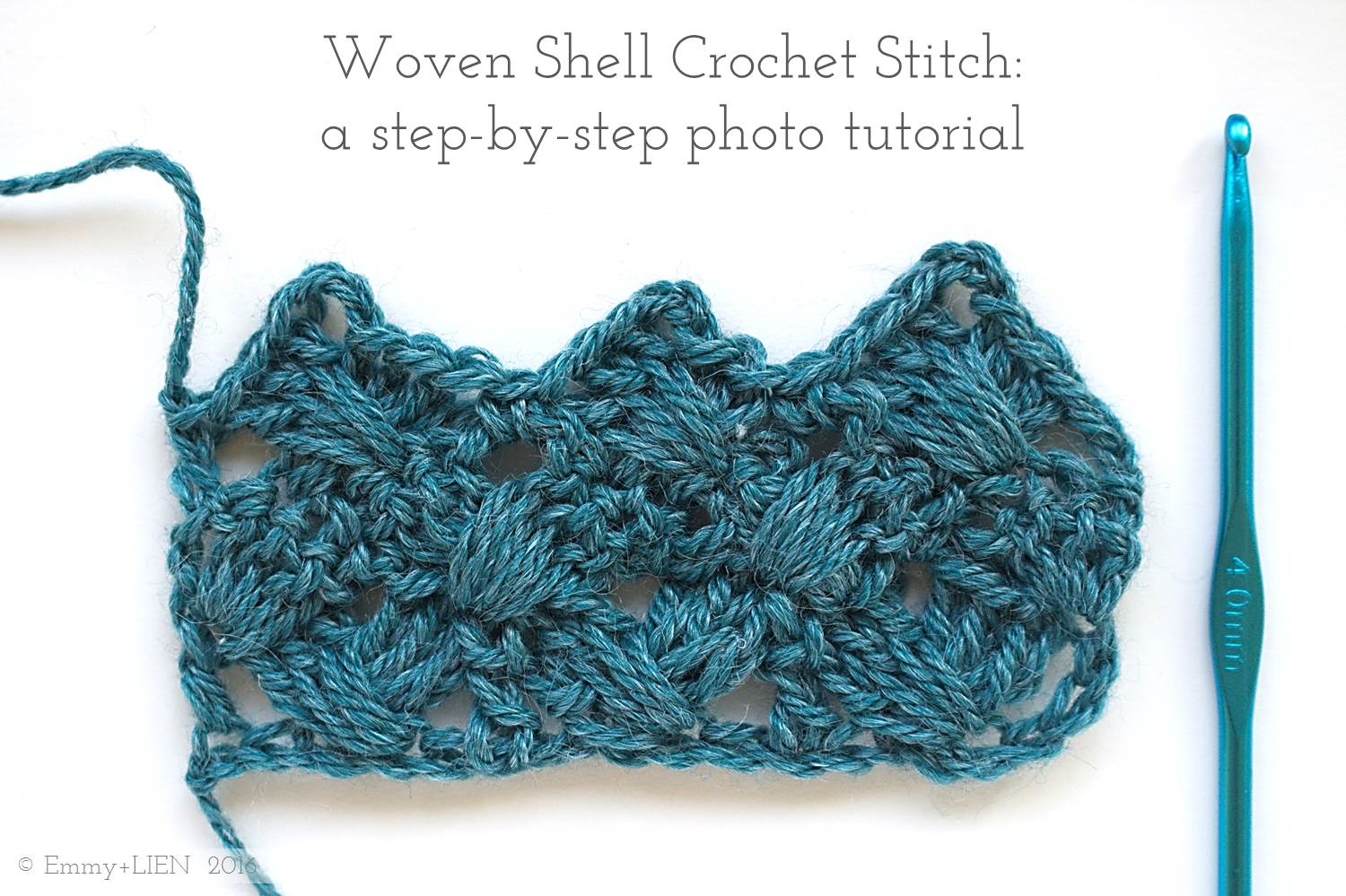
This step-by-step photo tutorial shows you how to work the "Woven Shell" crochet stitch. This stitch is much easier than it looks, and creates a beautiful, cable-like texture. It's a must-try for any crochet fan!
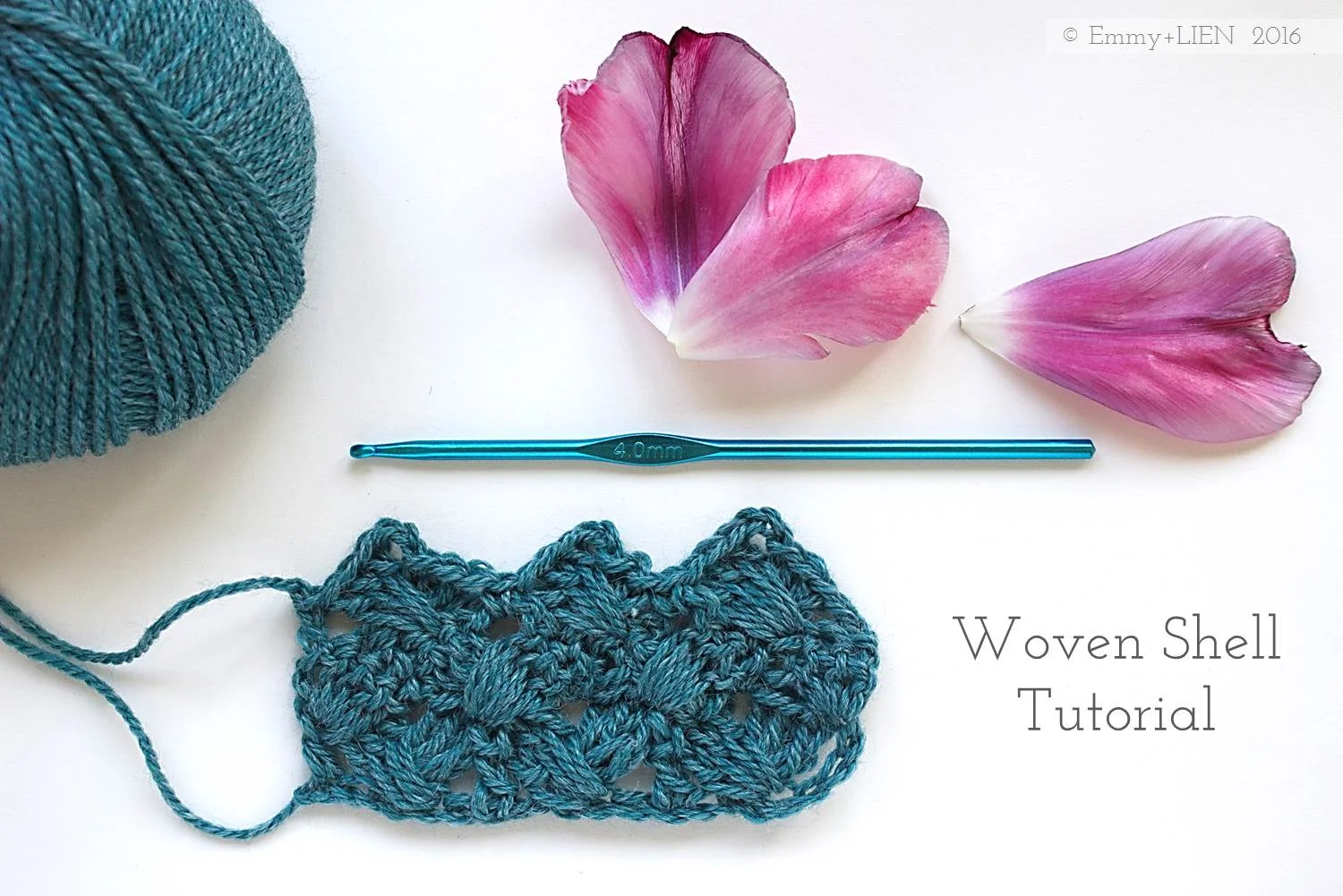
In this tutorial I will show you how to work the “Woven Shell” crochet stitch. It produces an amazing, cable-like texture that has the potential to add interest to so many different items - accessories, cardigans, even granny squares. What makes it so versatile is that, although there are overlapping stitches, the resulting fabric remains quite supple rather than rigid.
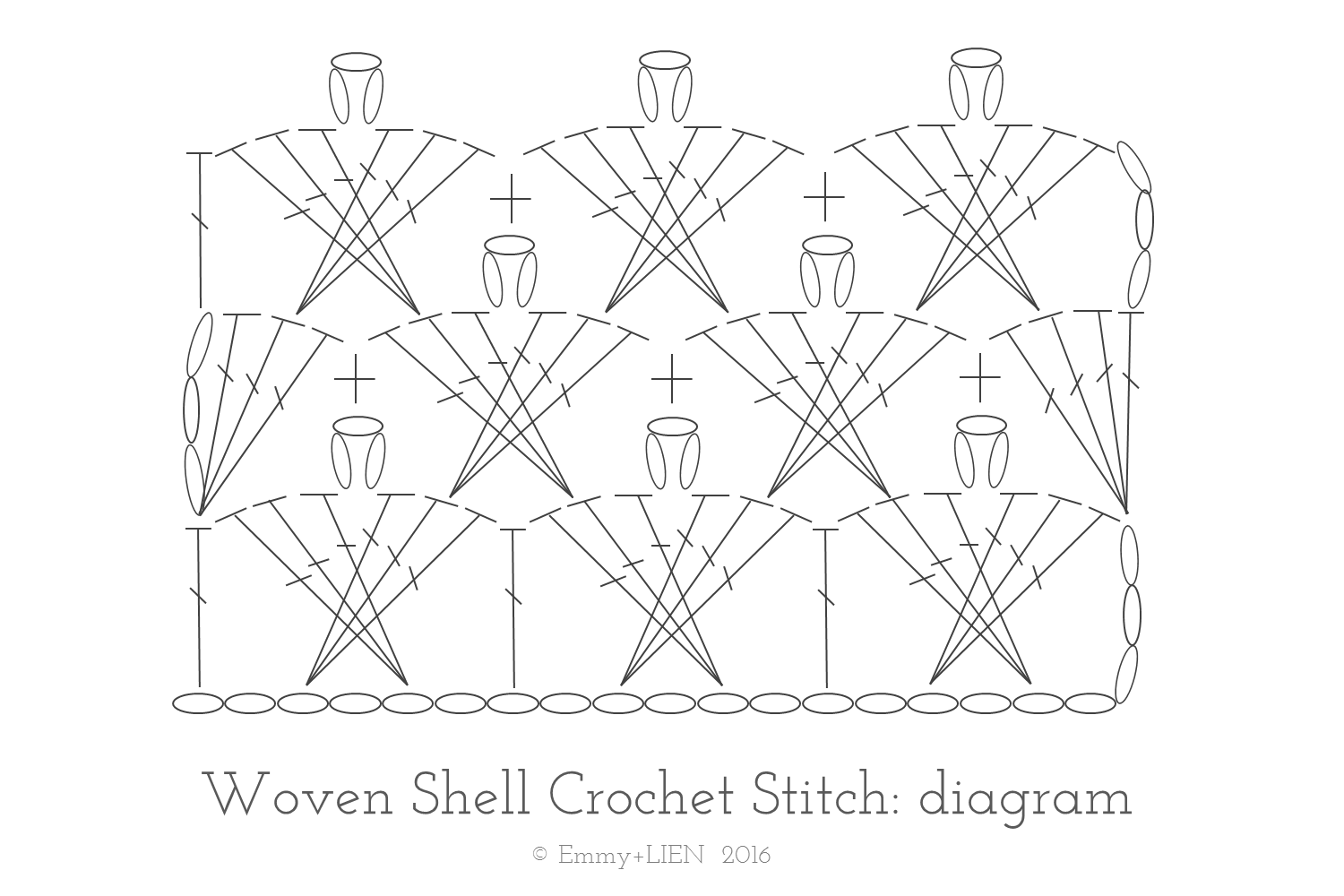
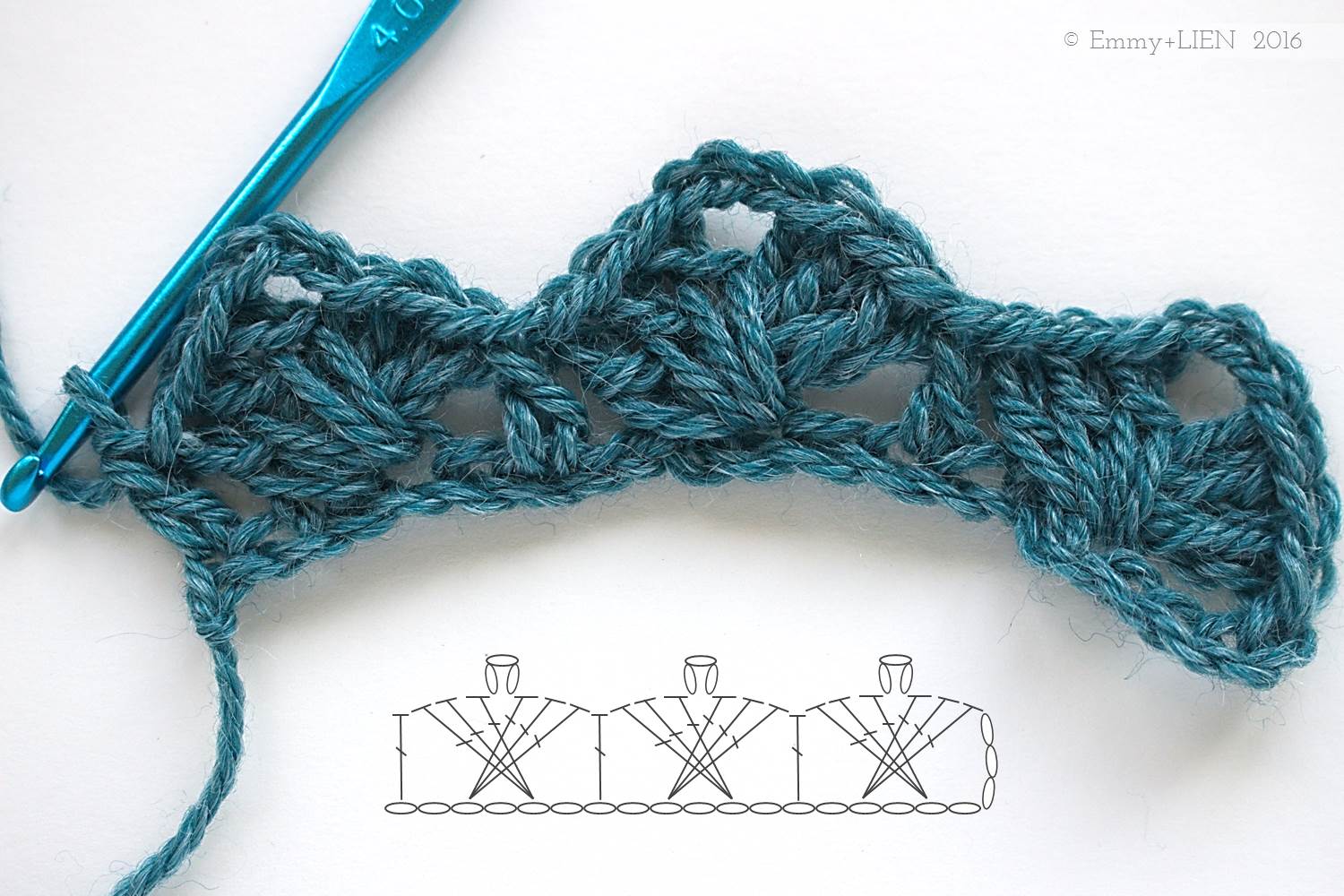
The Woven shelll stitch looks complicated, but you really only need to know basic crochet stitches: Chains, Treble Crochet - TC (Double Crochet if you use US terms), and Double Crochet (Single Crochet). I've included a diagram, but don't panic if you don't know how to read one of these - the photo tutorial and written instructions will walk you through each step.

The Woven Shell stitch will work with a variety of yarns, from lightweight cotton to heavy wool. That said, I personally like to use a DK yarn with a glossy finish in a light to medium colour, as it really shows off the texture of the parts where the stitches cross.
Materials:
4mm / size 6 crochet hook
DK yarn (for this sample, I’ve used No. 4 Organic Wool+Nettles in "petrol" by ONION)
Stitches + Abbreviations:
Chain - ch
Treble Crochet - TC
Double Crochet - DC
Difficulty:
Advanced beginner
Please note: this tutorial uses UK crochet terms
Starting chain:
work a multiple of 6, then add 3 to make the first TC. For this sample, I’ve chained 21:
18 (divisible by 6) + 3 = 21
R1:
Skip the first 6 ch. Ch. 7 is where you will start your first shell.
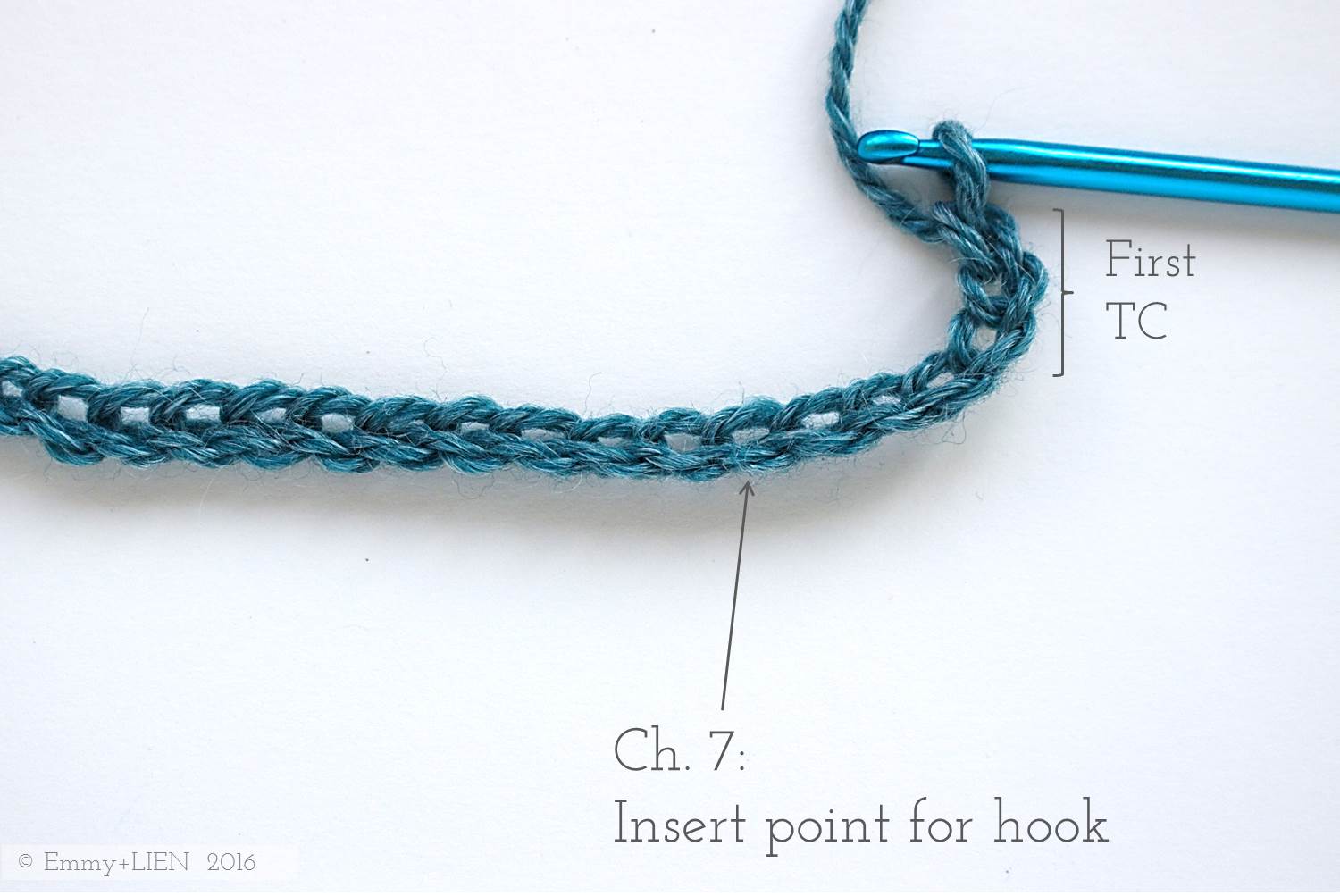
Yarn over, then TC in ch 7. Make sure the this TC is long.


TC 2 more in the same ch 7 space, to make a cluster of 3 TCs. To make the next 3 TC cluster, you will need to go backwards rather than forwards.

Going backwards, skip 1, ch 3, then TC 1 in ch 5 by yarning over and puling up a long loop around the cluster of 3 TCs.

TC 2 more in the same ch 5 to complete the cluster as well as the first shell.

Skip 1, then TC 1. The placement for the next Shell is shown below.

Skip 3, TC 3 in the next st, then ch 3. Going backwards, skip 1, then TC 3.
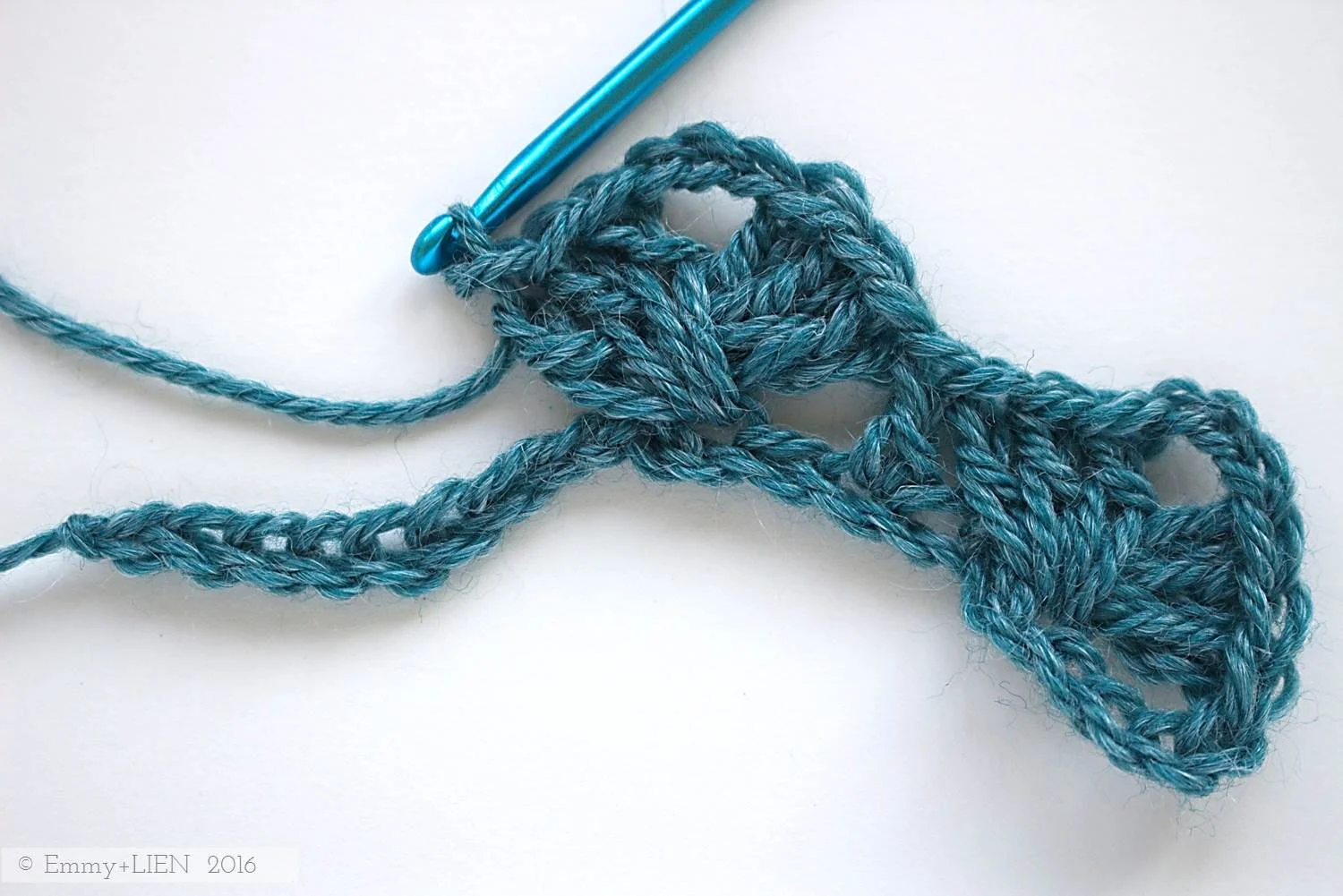
Going forwards again, skip 1 from the first set of TC 3 and DC 1.
Repeat for the last Shell: Skip 3, TC 3 in the next st, then ch 3. Going backwards, skip 1, then TC 3. Going forwards again, skip 1 from the first set of TC 3 and TC 1 in the last ch to complete the first row. Turn.
R2:
Ch 3 (counts as 1 TC), then TC 3 in the same st.

DC 1 around the top of the ch 3 of the woven shell underneath. The placement for the next Shell is shown below.

Skip the whole of the next 3-TC group, then TC 3 in the second (i.e. middle) TC of the next 3-TC group. Ch 3, then go back and TC 3 into the second (i.e. middle) TC of the 3-TC group just skipped to complete the Woven Shell.
DC 1 around the top of the ch 3 of the woven shell underneath. Skip the whole of the next 3-TC group, then TC 3 in the second (i.e. middle) TC of the next 3-TC group. Ch 3, then go back and TC 3 into the second (i.e. middle) TC of the 3-TC group just skipped.
DC 1 around the top of the ch 3 of the woven shell underneath. Skip the whole of the next 3-TC group, then TC 4 into the top of the turning chain of the previous row. Turn.

R3:
Ch 3 (counts as 1 TC), skip the whole of the 4-TC group, then TC 3 in the second TC of the next 3-TC group. Ch 3, then go back and TC 3 into the third TC of the 4-TC group just skipped.
* DC 1 around the top of the ch 3 of the woven shell underneath. Skip the whole of the next 3-TC group, then TC 3 in the second TC of the next 3-TC group. Ch 3, then go back and TC 3 into the second TC of the 3-TC group just skipped. Repeat from * until last st. TC 1 in the last ch 1 space.
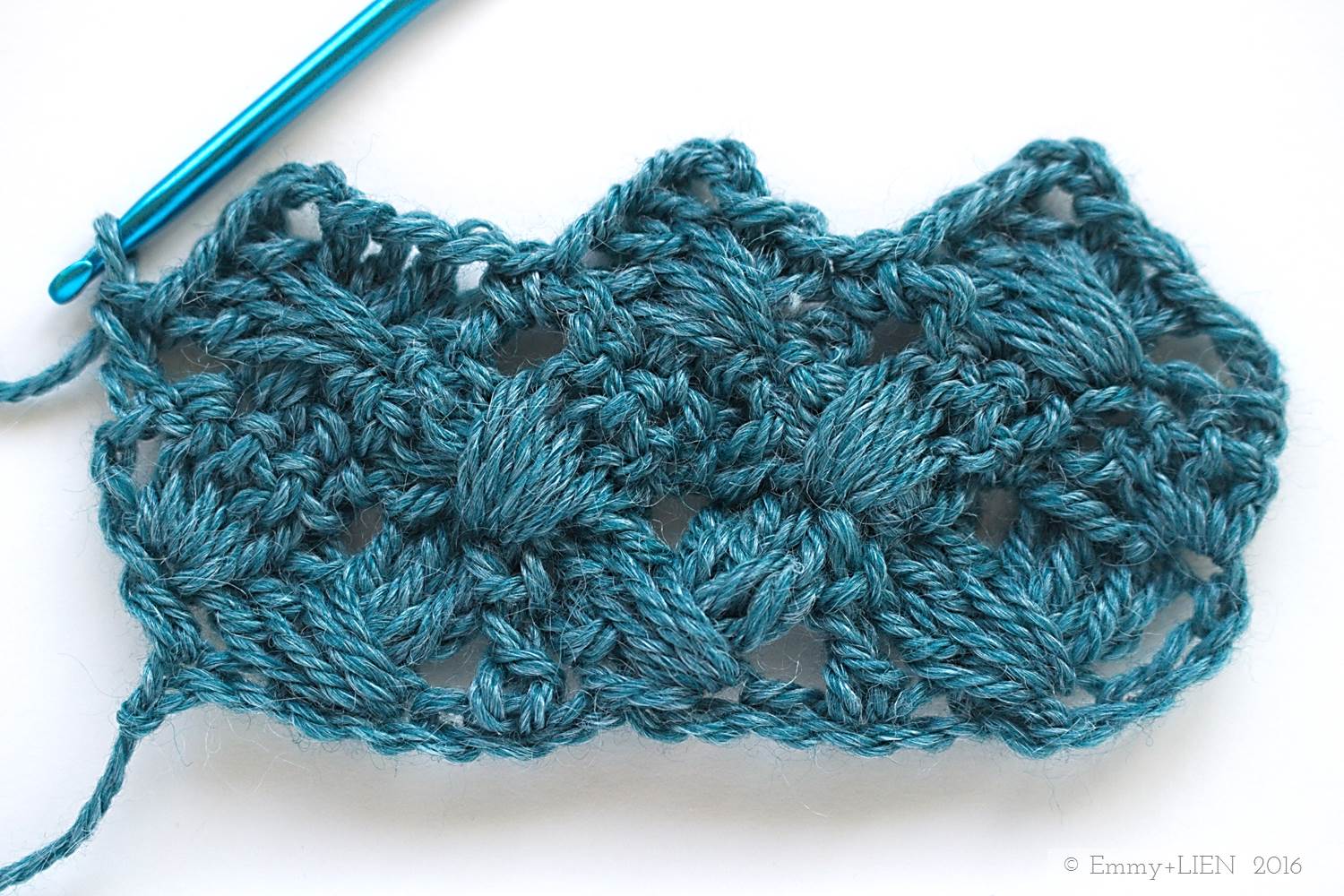

To continue, repeat rows 2 and 3 as many times as required.
So there you go, the Woven Shell. You might need a little practice on going back and forth and pulling up long enough loops to make the cross-overs, but hopefully this tutorial will have you creating beautifully textured pieces in no time. I'll be publishing the Lavender Skies Scarf, which is based on this stitch, later this month so if you like it, now is a good opportunity to start swatching!
